CURRENTLY ON VIEW


THE ART AND THE ARTISTS
Olivia Beens
Stephanie Brody-Lederman

Above left: Silhouette in Pearls, 2025, collage, image transfer, watercolor, gouache on wood panel with acrylic resin surface, 12 x12 inches.
Above Right: Needlework Girl, 2025, collage, image transfer, watercolor, gouache on wood panel with acrylic resin surface, 12 x12 inches.
"My Mother (Silhouette in Pearls) was a Czech woman who was a mystery to me. I searched old photos, wanted to discover who she was and who I was. It was not an easy relationship to either of us; we fought and struggled to survive. We spoke Czech, Dutch, Portuguese and English to communicate. I was a spirited child and found ways of coping, often with unexpected results.
Needle Girl is trapped in a web - trying to find her way in the world. The woman represents aspects of my mother; strong and remote. I wanted a mother who was more traditional, more of a homemaker. The type of mother depicted in 1950s TV."
Stephanie Brody-Lederman
Stephanie Brody-Lederman
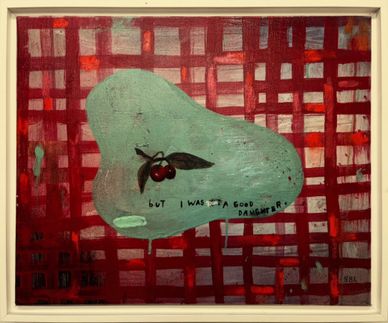
Above: I Was (not) a Good Daughter," 2025, oil, acrylic, graphite on canvas, 18 x 22 inches.
SARANIGHTINGALE.COM/STEPHANIE-BRODYLEDERMAN
"My painting relates to this show as it is about my relationship with my mother. In some ways I was a good daughter, and in other ways I was not a good daughter. This painting depicts that ambiguity."
Jody Culkin

Above left: Arcangela Tarabotti, 2026, digital print, 11 x 14 inches.
Above Right: Veronica Franco, 2025, digital print, 11 x14 inches.
"Arcangela Tarabotti was a cloistered nun in Venice in the 17th century. She wrote 7 works, though she never left the convent after age 11. Her best-known work, ‘Paternal Tyranny’, is a critique of the church, the treatment of women in society, and the practice of forcing girls considered
unmarriageable into the convent.
Veronica Franco was a poet and a courtesan who lived in Venice during the 16th century. She wrote and published two volumes, one a work of poetry and one a collection of letters. She was attacked by a fellow poet, Maffio Venier, in verse and responded: “When we too are armed and trained, we
can convince men that we have hands, feet, and a heart like yours.”
Larry Dobens
Angela Fremont
Above Left: My Mothers Holiday Tablecloth, 2020, watercolor on paper, 19 x 15 inches.
Above Right: Mom’s Old Bean Pot, 2021, oil on panel, 11 3/8 x 11 3/8 inches.
"I am happy to share the story behind two kitchen items that represent my mother and the traditions that defined our family culture.
The first is her beanpot. Growing up in New Hampshire, my mom baked Boston Baked
Beans in this pot every Saturday night without fail, served with "franks" and brown bread. I have fond memories of bringing a pot of these beans to the firehouse where my dad was on duty; the other firefighters loved her for it. I own the beanpot now, and I still use her
handwritten recipe—soaking the beans overnight and following her exact process.
The second item is her holiday tablecloth, which was used exclusively for Christmas and
New Year’s. After she moved to Florida, I was always glad to see it spread out on her table
during my visits. When I helped her pack for her final move from Florida to Tennessee, she
gave both the beanpot and the tablecloth to me. I now love having that same tablecloth
draped across our table for the holidays connecting forever our lives and carrying on the family tradition. These items are a beautiful embodiment of how my mother celebrated our
family and our traditions."
Toto Feldman
Angela Fremont
Angela Fremont
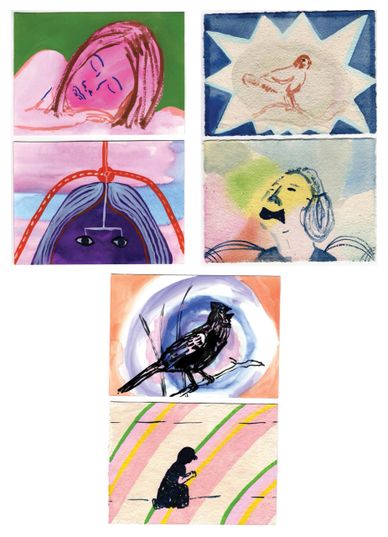
Above Left: Dream Again, Dream Better, 2020, gouache on paper, 8 x 11 inches.
Above Right: Striving, 2020, gouache on paper, 8 x 11 inches.
Above Center: Angel Tulsa, 2020, gouache on paper, 8 x 11 inches.
"TIMELINE:
My mother, also an artist, dies in the Spring of 2019.
That December, I begin to make a painting every day.
This is my interpretation of activities suggested by Jean who leads the grief group I am attending.
This project will end up as 227 paintings made consecutively.
All of these paintings are dedicated to my Mother who taught me to see the world through 'artist eyes'."
Angela Fremont
Angela Fremont
Angela Fremont
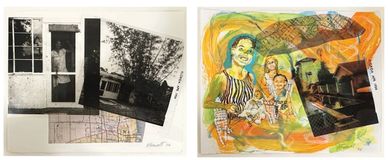
Above Left: The Screen Door, 2026, transparencies on rag, 12 x 14 inches.
Above Right: Mom, oh mom, 2026, Acrylic, transparencies, ink on acid free paper, 11 x 14 inches.
"The use of primary sources and archival materials has been part of my process for the past 50 years and become more essential in a time of questioned historical fact. A shadowy figure waves behind the screen door, a memory of a young mother surrounded by bamboo clacking in the wind, coyotes, owls, and nighthawks howling at the night. She played Chopin as I drifted off to sleep, called the farmer down the road to come with a pitchtork to kill the rattlesnakes that our big German Shepard flushed out, and sat in the grass peeling warm grapefruits, feeding us sections in the hot afternoon shade.
The pool, 6 feet deep in the shallow end. Mom, oh mom. Alone down the long dirt road with no one to call for help. No one to hear your cries in the night."
Janet Olivia Henry

Above: After Gauguin, 1980, oil pastel and colored pencil on handmade Japanese Mulberry paper, 15 x 13 inches. Image courtesy of the artist and Gordon Robichaux Gallery.
"After Gauguin satirizes Paul Gauguin's 1891 painting la Orana Maria. In lieu of a "primitive"
Madonna and child, you see a mother dealing drugs and a pimp with his stable of women. I wanted to show the lengths that mothers will go to care for their children. The drawing cannibalizes
Gauguin's paternalistic treatment of Tahitian people, and lays bare the struggles of women I saw in my neighborhood around the time I made this work."
Ellen Coleman Izzo

Above: Suzanne: Childhood Home, 2026, collagraph prints on subway map, 20 x 20 inches.
"This print was made for Our Mothers utilizing collagraph plates combined from two different series. Suzanne herself came from The Homeless Memorial, a series consisting of eleven different people
experiencing homelessness. The series was conceived while on an eleven-stop trolley tour of the monuments and memorials of Washington, DC, replete with pockets of unhoused going largely unnoticed between the stops. Recreating the trolley route with a very visible homeless contingent is
the objective for the series.
An unanticipated outcome of creating these eleven figures was naming them while making the collagraph plates. The act of cutting and piecing them together became very personal, and led to the battle cry, 'Homeless is not Nameless.'
Suzanne (not her real name) was actually based on a woman in my neighborhood with mental and addiction issues, and love for her two sons.
The Home Project is another series based on printmaking workshops open for the general public in different venues primarily in Brooklyn. Participants made collagraph plates of their idea of home, printed up many on paper and flags to take home, and donated the plate for me to use and print up
whole neighborhoods. The Home printed on this image is one of those donated plates."
Juanita Lanzo

Above Left: Bending will, v.3, 2020-25, watercolor pencil and ink on watercolor paper, 11 x 14 inches.
Above Right: Untitled (Bud, number 2), watercolor pencil and ink on watercolor paper, 11 x 14 inches.
"I am a visual artist based in The Bronx working primarily on paper. I draw as my primary means of expression, sourcing references to anatomy and the natural world. Bending will, v.3 (3 rd version) is
one of three versions centering on a bent/bowed biomorphic shape, surrounded by a variety of sinuous thin and thick shapes.
For Our Mothers, I am responding with work where my biomorphic forms are evocative of the memory of soft loving touch, memory, nurturing, and leaning.
Untitled (Bud, number 2) captures what can become an outgrowth of an organism that will
differentiate into a new organism.
For Our Mothers, this work alludes to growth, or the beginning, as a result of acts of nourishment, nurturing, and/or/and bestowing new life or its extension.
I draw using watercolor or water-soluble pencils, creating washed/translucent layers."
Mary McFerran

Above: Mothers Are Daughters, 2025, charcoal on paper, 11 x 9 inches.
"The ultimate experience of mothering is watching your daughter become a mother. In this drawing, I depict my daughter shortly after giving birth and breast feeding."
Sana Musasama

Above: I See Me Doll, 2025, ceramic, glass, wire, glass beads, 7 x 5 x 1 inch.
"I found an old wooden doll at my Aunt Ruth’s house. I believe it was a doll for a slave child. My great-great grandparents were slaves on a tobacco or cotton farm. I wonder who carved the wooden doll and wrote “I see me on the other side”. The dolls I make look sweet and extreme in an old black
humor style."
Bob Rivera

Above: Raquel's Ribbon, 2025, archival materials and poly lace on board, 24 x 20 inches.
"This lace ribbon shape depicts my mother’s life through her years in New York City as a daughter, wife, mother, sister, aunt, friend, worker and inspiration of life. Her journey through life encompassed a growing knowledge and experiences as listed above. Her sharing of those attributes endowed her
with a larger-than-life persona while having a petite stature. As a single mother and full-time working citizen she pre-dated the women’s liberation development and so her opinions were respected by her family, neighbors and co-workers. Raquel, Rachel, Rae, Raquelita, Ms Roman or Mom, she was
known by her affectionate nature and as a supreme and loved human being."
PANGEA's CaBARET ROOM

Above: Carol Lipnik performing in Pangea's then-new Cabaret Room in 2016, with Walker's installation Leon Waller: Boats and Boats from Above on the walls.
Pangea Restaurant and Bar has been a vital creative force in the East Village for more than 40 years. Originally opened in 1986 as La Spaghetteria, owners Arnoldo Caballero and Stephen Shanaghan reinvented the space in the mid ’90s as Pangea. With a fresh menu, redesigned interior, and art installations by neighborhood artists, it soon became a home away from home for the city’s creative community—described by The New York Times as “a bohemian oasis not unlike Max’s Kansas City in the New York gone by.”
In 2015, Pangea began presenting live performances in one of their dining room spaces, and that has evolved into the now-legendary Cabaret Room. Hosting over 200 performances annually—from traditional cabaret to experimental multimedia, classical, jazz, drag, personal storytelling, 8and more. Walker did several informal art installations in the Cabaret Room over the next few years (as shown in the image above—with battery operated picture lights!).
In 2026, Wendell Walker Design began officially managing the installations of art throughout Pangea alongside organizing special changing exhibits in the Cabaret Room. With Walker’s new contributions (starting with a new built-in lighting system for the art on view) Pangea continues to grow as a gathering place for artists and lovers of the arts in all its forms.
The art exhibitions that live within Pangea’s Cabaret Room offer a quiet dialogue with the room itself—adding texture, atmosphere, and a visual rhythm that resonates alongside the music, voices, and stories unfolding on stage. Visitors are encouraged to enjoy the art exhibitions during stage performances but may also view the exhibitions most evenings from 5:00 pm to 6:30 pm before that evening’s 7:00 pm cabaret show (depending on show setup requirements), or after the show has ended. On nights without performances, exhibitions may be viewed any time.
Pangea’s hours are Tuesday–Thursday, 5:00–10:00pm, and Friday–Sunday, 5:00–11:00pm (closed Monday).
Check Pangea’s online calendar to confirm daily show times: pangeanyc.com/music/